
BYOC for Enterprise
Run It Where You Want. Not Where They Built It.
Vendor software and internal workloads are locked to one cloud in one region. You need them in your cloud, your sovereign jurisdiction, your VPC, or your own data center. Tensor9 makes it possible without re-architecture.
The Gap Between What Vendors Build and Where You Need It
Best-in-class software is built for one cloud in one region. Getting it into your cloud, your region, or your VPC requires re-architecture that vendors won’t do and your team can’t justify.
Cloud Concentration Risk
Each vendor builds on their preferred hyperscaler. Their procurement decision becomes your concentration risk. Vendor apps plus internal workloads silently accumulate on a single provider, eroding your negotiating leverage and increasing single-provider exposure.
Sovereign Requirements
GDPR, DORA, and local banking regulations require infrastructure in-jurisdiction. But best-in-class software is built for US hyperscalers. EU sovereign, APAC, and on-prem support is an afterthought, if it exists at all. Per-jurisdiction customization doesn’t scale.
Data Can’t Leave
Security policy, compliance mandates, or customer contracts require vendor software to run inside your VPC, your data center, or an air-gapped network. Most vendors don’t offer this, and the ones that do ship a degraded, hard-to-maintain version.
The Integration Tax Multiplies
Each vendor needs its own integration with your enterprise tools: CrowdStrike, Splunk, Tailscale, Vault. Multiply by vendors, by tools, by jurisdictions. The result is O(n × m) integration work that grows quadratically.
The Multi-Cloud Chassis for Enterprise Software
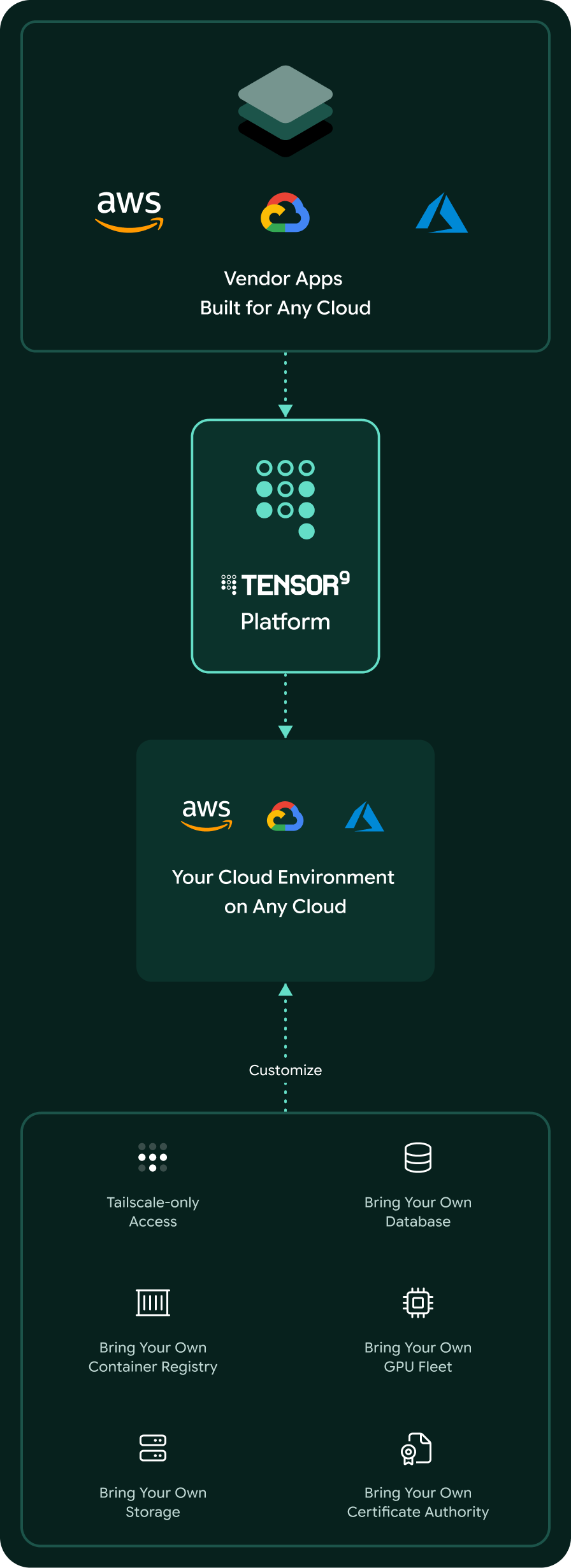
Tensor9 is the chassis that any workload runs on: vendor, internal, or open-source. You choose the cloud and the chassis controls the infrastructure around apps. Your Terraform in, your Terraform out. Nothing proprietary injected.
Multi-Cloud & On-Prem Portability
Deploy vendor software built for any cloud into your preferred environment, including on-prem data centers and air-gapped networks that cloud-only platforms can’t reach. Tensor9 rebuilds infrastructure definitions for your target: AWS to GCP, Azure to on-prem, US hyperscaler to EU sovereign. No code rewrites, no vendor involvement.
Bring Your Own Everything
Override vendor infrastructure decisions at the chassis level. Swap self-managed PostgreSQL for Aurora for the API surface your application uses, vendor certs for your CA, bundled Kafka for your Confluent cluster for the API surface your application uses, or direct ingress for Tailscale. Your managed services, your policies, applied to every workload.
Policy Survives Every Upgrade
When a vendor releases v2.0, Tensor9 rebuilds with your customizations intact. No re-hardening treadmill. No manual security review per release. Every customization persists automatically across upgrades, with a full diff before you approve deployment.
Universal Tool Integration
Plug your enterprise tools into the chassis once and they work with every vendor, in every environment. One CrowdStrike config, one Splunk policy, one Tailscale network, applied consistently. Reduce integration complexity from O(n × m) to O(n + m), where n is the number of vendors and m is the number of environments, so you integrate each tool once instead of once per vendor per environment.
Sovereign & Regulatory Compliance
Deploy into EU sovereign, UK, APAC, or on-prem environments with data residency enforced by construction. Swap US KMS for sovereign HSM, US databases for in-jurisdiction managed services for the API surface your application uses, and vendor certs for jurisdiction-specific CAs. No vendor negotiation required.
Full Audit Trail
Every rebuild, policy application, and infrastructure change is logged. Scoped permissions control who can approve deployments, access environments, and review changes. Exportable audit logs for compliance reviews across every vendor, every cloud, every jurisdiction.
How Tensor9 Works
Tensor9 is the chassis that vendor software runs on in your environment. Vendors ship the application. You choose the cloud. The chassis controls the infrastructure around it: permissions, network, encryption, monitoring, and your enterprise tools.

Frequently Asked Questions
Tensor9 is the enterprise chassis that vendor software runs on in your environment. The vendor ships the application. You choose the cloud, the region, and the infrastructure. Tensor9 handles the translation between what the vendor built and what your environment requires.
- Run vendor software in your VPC: deploy vendor apps into your own cloud account or on-prem infrastructure, keeping sensitive data within your perimeter.
- Choose your own cloud: vendor built for AWS but you run GCP or Azure? Tensor9 rebuilds the infrastructure so you don’t have to wait for vendor support.
- Sovereign and regulatory compliance: run vendor software in EU sovereign, APAC, or on-prem environments with data residency enforced at the infrastructure level, meeting GDPR, DORA, OCC, FFIEC, and FHFA requirements.
- Enterprise standardization: apply your preferred managed services, security tools, and compliance policies uniformly across all vendor deployments.
Virtually any environment: your VPCs on AWS, Azure, or GCP, private data centers, air-gapped networks, and sovereign clouds, all with or without Kubernetes. The deployment experience remains consistent regardless of underlying infrastructure.
No. Tensor9 works with vendor infrastructure definitions as-is. The application code stays identical. Onboarding a vendor onto the chassis is real integration work that Tensor9 performs, but that work lands in the infrastructure layer, not in the vendor’s own application code, which never changes. Only the infrastructure layer is translated for your target environment.
For a new vendor onboarding to Tensor9, a typical engagement takes 1 week for discovery, 1 to 3 weeks for integrations, and 1 to 2 weeks for review and hardening. Once a vendor is onboarded, deploying into a new environment takes hours to days. Compare either path to the 6 to 12 month re-architecture cycle required without Tensor9.
Applications run entirely within your environment. Sensitive data never leaves your perimeter. Tensor9 receives only operational metadata: software versions, controller status, and resource capacity.
No. Tensor9 complements Kubernetes. It supports deployment to your managed Kubernetes clusters and handles the infrastructure layer around them: cloud services, networking, IAM, encryption, and enterprise tool integration.
No. Tensor9 works with standard Terraform and Kubernetes definitions. Your infrastructure-as-code goes in, and standard infrastructure-as-code comes out. Nothing proprietary is injected into the translated output. You can inspect, audit, and run the result independently at any time.